Best Time to Visit the Everglades From Miami
The Everglades has two seasons, and they produce two different trips. Month-by-month advice on wildlife, mosquitoes, heat and what to book, grounded in park weather data.
South Florida does not really have four seasons. It has a wet one and a dry one, and which one you book into changes the Everglades more than any choice of operator will. The dry season — roughly December to April — is the better trip, and it is not close: water levels drop, wildlife concentrates around what is left, humidity falls away and the mosquitoes become a nuisance rather than a feature of the day.
That does not make summer a write-off. If your dates are fixed, there are sensible ways to handle a July booking, and prices are softer. But you should know which trip you are buying.
Check Availability
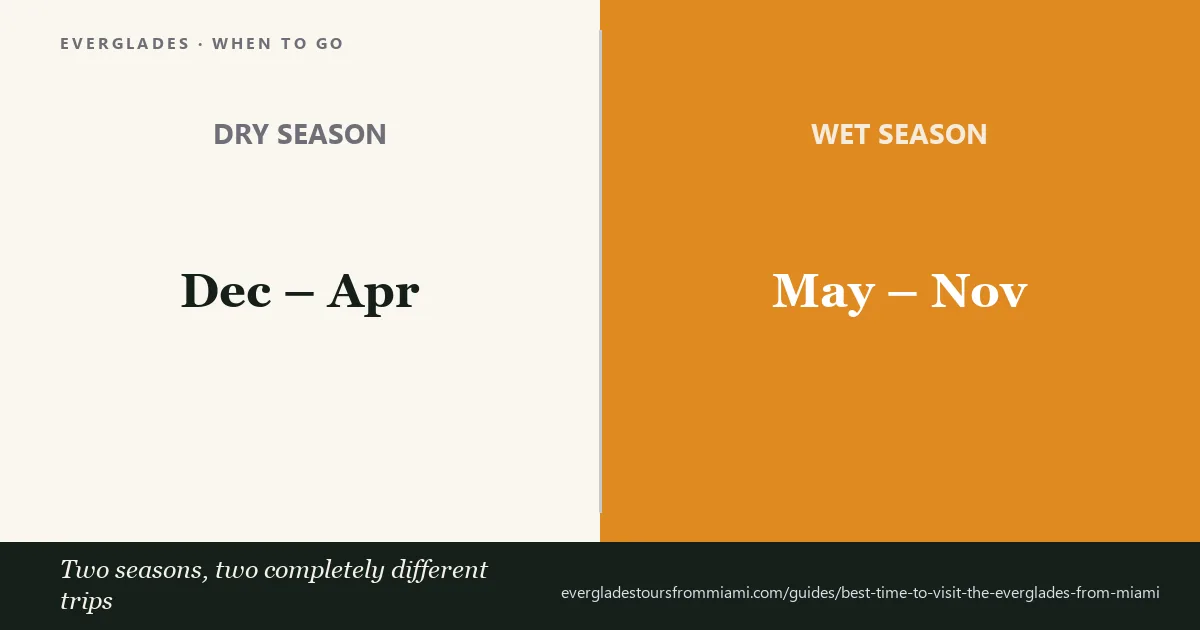
The two seasons, in the park’s own numbers
The National Park Service splits the Everglades year cleanly. The wet season runs from about mid-May to November, with temperatures into the low 90s Fahrenheit (30–35°C), high humidity, and daily thunderstorms delivering the bulk of the region’s roughly 60 inches (152 cm) of annual rainfall.
The dry season runs from about December to mid-May, with temperatures from the low 50s to the upper 70s Fahrenheit (12–25°C) and low humidity. South Florida receives only about a quarter of its yearly rainfall across those months.
Visitor guidance from the park usually frames the good window slightly wider — November through April — because November is already drying out and comfortable even though the meteorological dry season has not formally started. For booking purposes, treat November to April as the window and December to March as its heart.
Why the dry season is genuinely better, not just more comfortable
The comfort argument is obvious. The wildlife argument is the one that matters.
As the water table falls, the marsh stops being an evenly flooded sheet and becomes a network of gator holes, sloughs and remaining channels. Every animal that needs water is therefore in a predictable place, and alligators, wading birds, turtles and herons concentrate in numbers you will not see in August. This is why nearly every photograph on every Everglades listing was taken in winter.
Mosquitoes follow the same curve in reverse. They are at their lowest in the dry season, though the park is clear that they persist at dusk and dawn and in shaded areas — repellent is still worth carrying in January. At the other end, September is the worst month of the year for them, sitting at the tail of the wet season when standing water has had all summer to do its work.
Temperature does one more useful thing in winter: it pushes alligators onto banks to bask in the sun, which is precisely where you can see them from a boat.
What this means for each kind of tour
Seasonality does not hit every tour on this site equally.
Airboat rides are the least weather-dependent. They run rain or shine year-round, and the boat is moving fast enough that insects are not an issue while you are on the water — it is the waiting around at the landing that bites. A walk-up airboat ticket works in any month (our breakdown).
Walking tours suffer most in summer. The naturalist-guided walk and airboat spends half its day on foot in hardwood hammock, which in August means heat, humidity and insects at once. In January it is one of the best things you can do in South Florida.
Full-day expeditions are the most seasonally sensitive of all. The nine-hour trip to Big Cypress and the Ten Thousand Islands is nine hours outdoors, and the boat cruise in the islands is far more pleasant in flat winter conditions than under a building thunderhead.
Covered versus uncovered boats becomes a real question in summer. At least one operator swaps boat types depending on heat index and occupancy, so an August booking may put you on an open boat in full midday sun.
Booking a summer trip without regretting it
If your dates are in the wet season, three adjustments do most of the work.
Book the earliest departure of the day. Thunderstorms in the Everglades are an afternoon phenomenon; a tour leaving at 7:30 AM is usually finished before the sky does anything interesting. The small-group tours here run exactly that early.
Choose a tour that includes transport in an air-conditioned vehicle rather than a walk-up ticket. The drive is an hour of relief each way, and it means you are not sitting in a hot car park waiting for the next boat.
Carry serious insect repellent and reapply it. Several operators exclude repellent from what they provide and say so in the listing; a couple include it. In September in particular, treat this as equipment rather than an afterthought.
And book with free cancellation. Most tours on this site refund in full up to 24 hours ahead, which in a season of daily storms is worth more than any discount.
Month by month, briefly
December to February — the peak. Cool, dry, low humidity, excellent wildlife, minimal insects. Also the busiest and the priciest, so book ahead.
March and April — still dry and still very good, with warmer days. April is the quiet sweet spot as the winter crowds thin but the water has not yet returned.
May — the turn. Early May behaves like the dry season; by the end of the month the rains have usually started.
June to August — hot, humid, wet most afternoons, with wildlife dispersed across a flooded marsh. Perfectly doable on an early departure; not the month to book a walking tour.
September — the hardest month: peak mosquitoes, peak humidity, peak storm risk. It is also the cheapest, and if you are set on going, an airboat-only ticket is the format that copes best.
October and November — recovering fast. By mid-November the marsh is drying, the birds are returning and conditions are close to winter quality without winter prices. For value against experience, November is arguably the best month of the year to come.
Frequently asked questions
What is the single best month to visit the Everglades?
January, if you want the textbook version: the driest, coolest part of the year with wildlife concentrated around remaining water and minimal insect pressure. If you want most of that at a lower price and with fewer people, November is the better-value answer.
How bad are the mosquitoes really?
It depends entirely on the month. In the dry season they are present at dusk and dawn and in shaded areas but manageable with repellent. In the wet season they are a genuine factor, and September — the tail of that season — is the worst of it. On an airboat moving across open water they are rarely a problem; it is the landings, the walks and the waiting that matter.
Do Everglades tours run in summer?
Yes, all year. Airboats run rain or shine, and most operators maintain their normal schedules through the wet season. What changes is the comfort and the wildlife density, not the availability. Book the earliest departure of the day to stay ahead of the afternoon storms.
Is it worth going in the rain?
An airboat ride in light rain is fine and the operators expect it. A full-day walking and boating itinerary in a thunderstorm is not much fun, and lightning can delay boats. Since most tours here cancel free up to 24 hours ahead, check the forecast the day before and move your booking if the afternoon looks bad.
When is the best time of day for an airboat tour?
Early morning or late afternoon. Both are cooler, both have better light for photographs, and both are when alligators are most active. The middle of the day in summer is the worst combination of heat, glare and dispersed wildlife.
Ready to book? Compare every Everglades tour from Miami →
Related reading:
See the River of Grass for Yourself
Airboat departures every 20 to 30 minutes inside Everglades National Park, 40 minutes west of downtown Miami. Free cancellation up to 24 hours ahead.
Check Availability & Book